You probably saw LSSBB on a job posting, a colleague’s LinkedIn, or maybe someone’s resume. And you’re wondering, what does that actually mean? What do these people do?
Good question. I’ll give you the straight answer. What the letters stand for, what Black Belts actually do day-to-day, what they earn in the US right now, and how the certification works. No padding, no fluff.
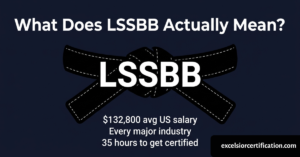
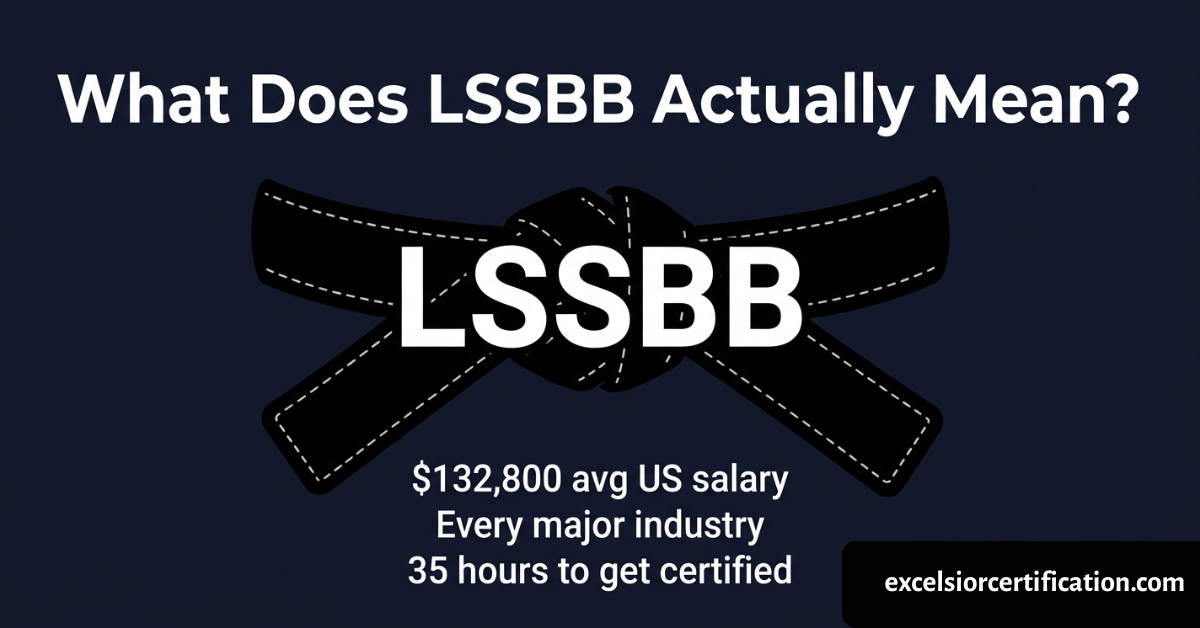
Quick answer if you just want the basics: LSSBB stands for Lean Six Sigma Black Belt. It’s an advanced certification for people who lead complex process improvement projects. The average salary in the US is $132,800 a year. (Source: Salary.com, 2026)
Table of Contents
What LSSBB Actually Stands For
Let’s go letter by letter because that’s the easiest way.
L is Lean. That comes from Toyota; they built a whole system around cutting out anything in a process that wastes time or money. Not just physical waste. Wasted steps, waiting around, doing things twice. All of that.
SS is Six Sigma. Motorola came up with this in the 1980s. It’s about reducing mistakes and inconsistency using actual data and statistics. The name “six sigma” is from statistics; it means a process that produces fewer than 3.4 defects per million. So basically, rarely get it wrong.
BB is Black Belt. Same idea as martial arts. It means you’re running the project, not just helping with it.
Put it together: Lean Six Sigma Black Belt. Someone who uses both Lean and Six Sigma to lead improvement work at a high level.
“The way I explain it to new students is, Lean asks are we doing things we don’t even need to be doing, and Six Sigma asks why do we keep getting different results. A Black Belt is trained to ask both at once, and actually has the tools to find the answers.” – Paula S. Shafer, LSSBB, PMP, Lead Instructor, Excelsior Certification
What Lean Six Sigma Means in Plain Language
People overcomplicate this. It’s actually pretty straightforward.
Lean is about eliminating waste. And waste doesn’t mean garbage. In Lean, waste means anything that doesn’t add value for the customer. Waiting. Extra steps nobody asked for. Making more than is needed. Moving things around for no reason. Lean tries to cut all of it out so the process runs faster and cleaner.
Six Sigma is about accuracy. If you’re making a product or delivering a service, how often do you get it wrong? And why? Six Sigma uses statistics to find the actual root cause, not just the symptom everyone’s been complaining about for years.
Combine them, and you get Lean Six Sigma. Faster and more accurate. That’s why it works in basically every industry there is.
Companies like Toyota, GE, Amazon, Bank of America, the Mayo Clinic, Boeing, they all use this. It’s not a niche methodology. It’s everywhere.
What a Black Belt Actually Does at Work
Okay, so this is probably the part you actually want to know.
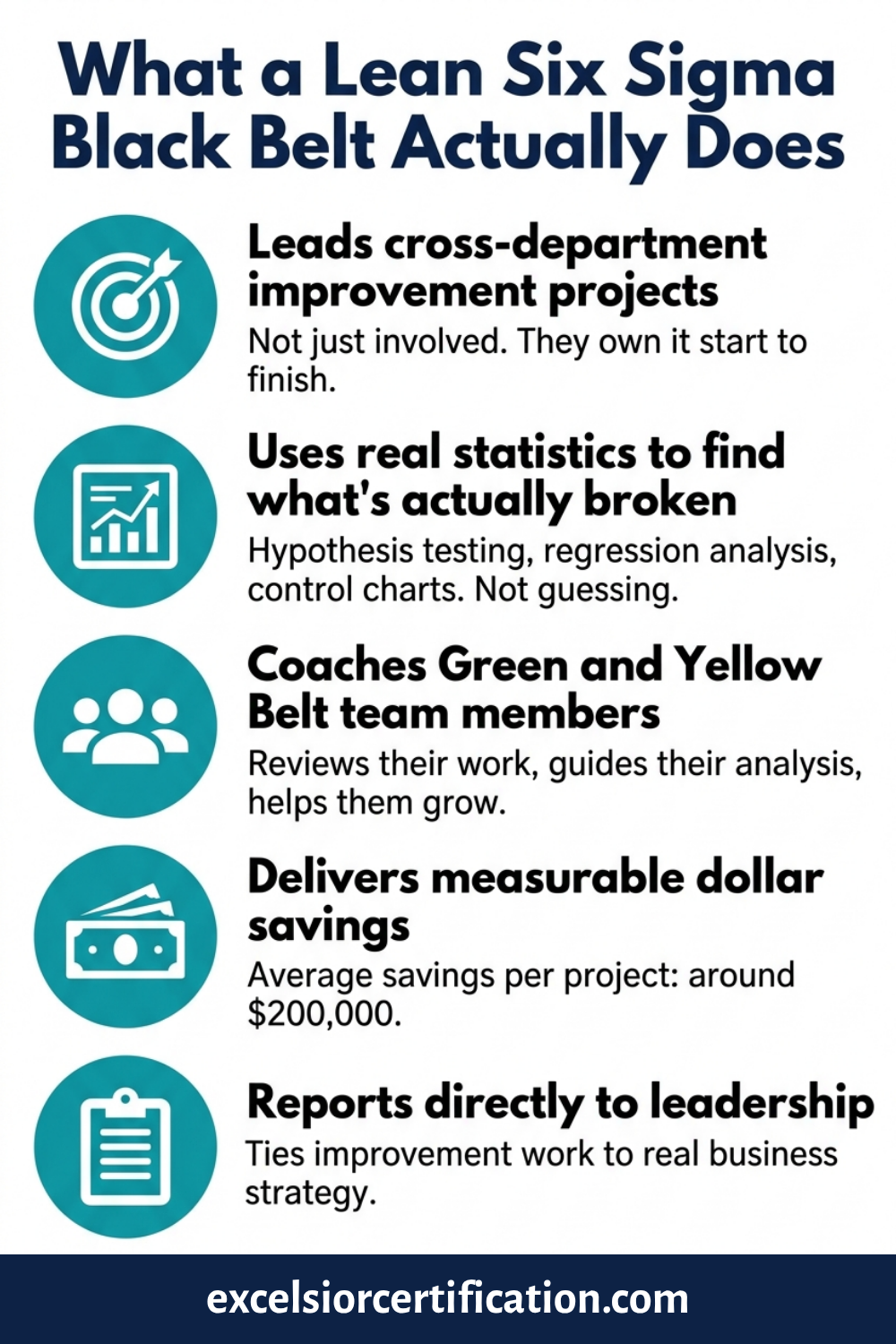
A Black Belt runs projects. Not sitting in meetings about them. Actually runs them, the kind that cross multiple departments, deal with messy data, and are expected to produce real dollar savings.
Picture this. A hospital has a billing error problem. Errors are happening constantly, patients are getting wrong charges, and the team is frustrated. A Black Belt comes in, maps the whole billing process, collects data on where errors actually happen, runs statistical analysis to find which specific step is causing 80% of the problems, proposes a fix, runs a small pilot to test it, and then creates a control plan so the improvement doesn’t slowly disappear in three months. That’s one project.
Or in manufacturing. A production line has a 4% defect rate when it should be under 1%. The Black Belt figures out which inputs, temperature, speed, and machine settings are causing the variation. Uses hypothesis testing to confirm it. Adjusts the parameters. Documents everything. Done.
According to ASQ, Black Belts “lead problem-solving projects and train and coach project teams.”
(Source: ASQ.org) And on average, a single well-run Black Belt project saves a company around $200,000.
They also mentor Green and Yellow Belts. So part of the job is reviewing other people’s work, catching mistakes in their analysis, and helping them get better.
DMAIC – The Framework They Use on Every Single Project
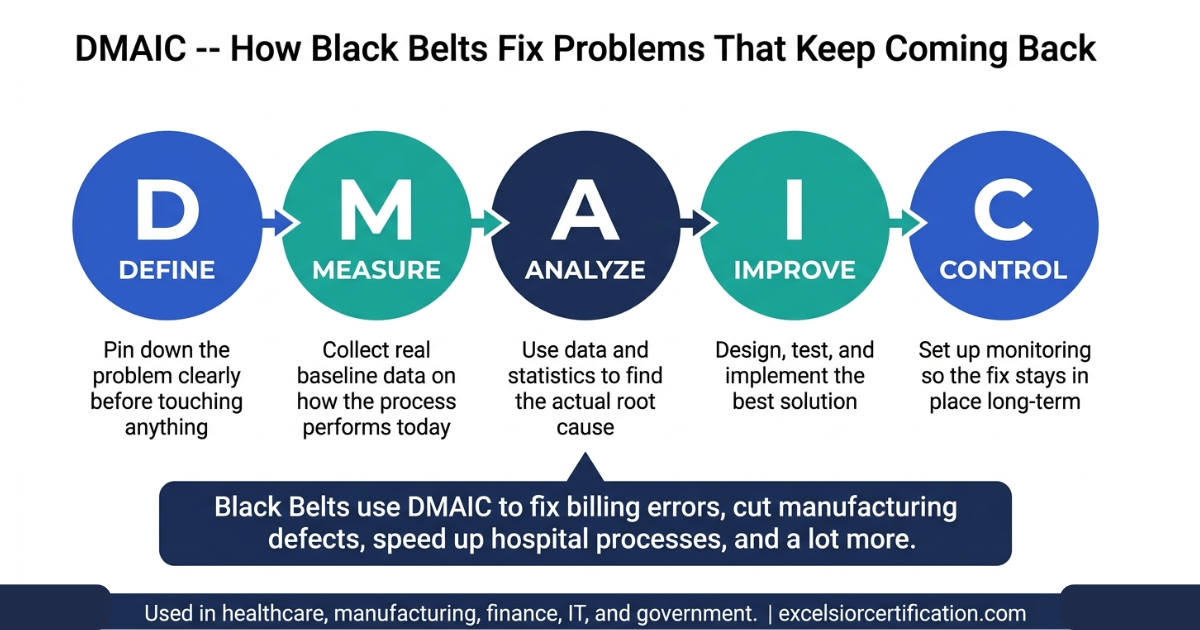
Every Lean Six Sigma project follows a five-step framework called DMAIC. This is what Black Belts actually use day to day. If you understand DMAIC, you basically understand how they think.
D is Define. Before touching anything, you pin down the problem clearly. Who’s affected?
What does success look like? What’s the timeline, and what savings are expected? Black Belts write a Project Charter here, a document that locks down the scope before anyone starts changing things.
M is Measure. You collect real data on how the process is actually performing right now. Not how people think it’s performing.
Not last year’s numbers. Today’s baseline. You can’t improve something you haven’t measured.
A is Analyze. This is where the real Black Belt work happens. Tools like Pareto charts, fishbone diagrams, hypothesis testing, and regression analysis.
The goal is to find the actual root cause, not the symptom, not people’s opinions about it. The actual cause backed by data.
I am improving. Design a solution, run a small pilot, test it, refine it, then roll it out when you have data showing it works. Black Belts don’t just implement the first idea someone suggests.
C is Control. This is the part most people skip and then wonder why problems come back six months later. Black Belts create control plans and monitoring systems so the fix stays in place after they hand the project over.
Real example: Johns Hopkins Hospital applied Six Sigma through each of these phases to improve patient satisfaction and reduce process errors. By tracking actual data at every stage rather than going straight to solutions, they found and fixed root causes that had been missed for years.
Belt Levels – Yellow vs Green vs Black vs Master
The belt system confuses people. Here’s the honest version of what each level actually means.
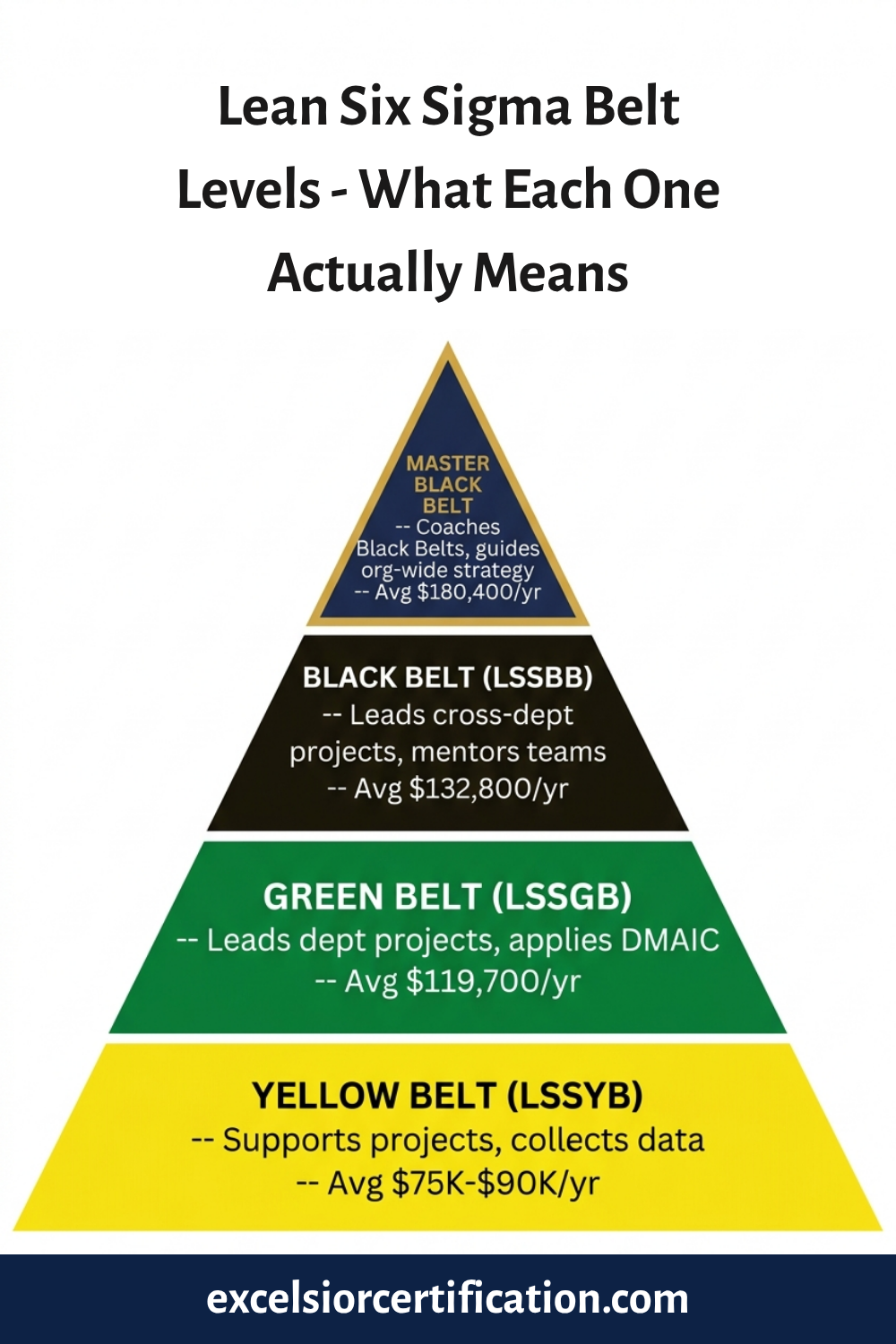
The Yellow Belt is entry-level. You know the concepts, you can support a project, collect data, and help with some analysis. You’re not leading anything. Good starting point if you’re completely new to this.
Green Belt is where you start actually leading projects, but typically within your own department. You know DMAIC, you can handle moderate statistics, and you probably do improvement work part-time alongside your regular job. Maybe 25-50% of your time.
Black Belt is a real leadership role. Projects that cross departments, involve complex data, and change management. A lot of Black Belts spend 50-100% of their time on improvement work. You’re also the person Green and Yellow Belts come to for guidance.
Master Black Belt is where you stop running projects yourself and start coaching the people who do. Strategy level, internal consulting, developing other Black Belts. Highest-paying level. Requires years of Black Belt experience to even consider.
| Yellow Belt | Green Belt | Black Belt | Master Black Belt | |
| Project scope | Small, local | Department | Enterprise-wide | Org strategy |
| Training | 8-16 hours | ~40 hours | 35+ hours | Advanced |
| Stats depth | Basic | Moderate | Advanced | Expert |
| Mentors | Nobody | Yellow Belts | Green + Yellow | Black Belts |
| Avg US salary | $75K-$90K | $119,700 | $132,800 | $180,400 |
(Source: Salary.com 2026)
One question I hear a lot: Do I need a Green Belt before going to Black Belt?
Honestly, no. Black Belt training covers everything from the beginning. But if you’re brand new to statistics and process improvement, starting at Green Belt gives you more practice time before diving into the harder material.
“Students ask me this constantly: Can they skip Green Belt? If they’re already in a leadership or senior operations role and comfortable with data, yes, they’re ready for Black Belt. If they’ve never touched DMAIC or statistics before, Green Belt first makes the Black Belt experience a lot less overwhelming.” – Paula S. Shafer, LSSBB, Excelsior Certification
Not sure which level fits?
Compare them here:
Lean Six Sigma Black Belt Training
Lean Six Sigma Green Belt Training
Still deciding which belt level makes sense for you?
Download the free Belt Comparison Guide – one page, which shows how Yellow, Green, and Black Belts differ by training, salary, and career fit.
LSSBB Salary in the US – 2026 Numbers
Let’s get to the part most people actually care about.
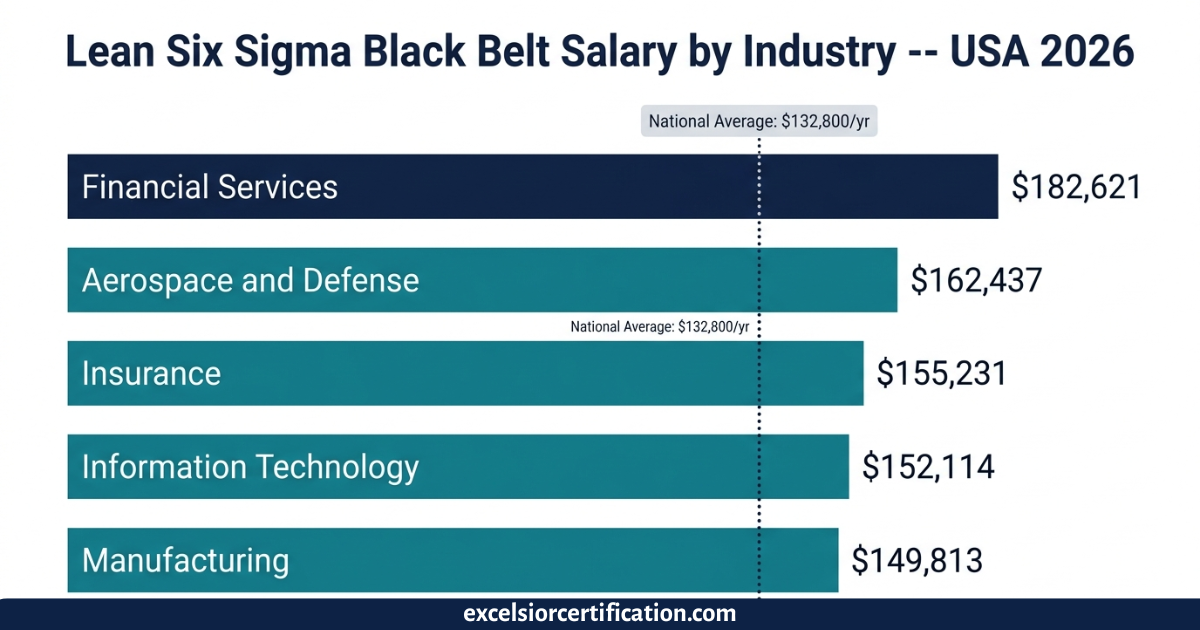
The national average salary for a Lean Six Sigma Black Belt in the US is $132,800 a year, according to Salary.com (2026). ZipRecruiter puts it at $129,499 as of March 2026, with most people falling somewhere between $122,000 and $137,000. Top earners hit $141,500 or above.
But the industry you’re in makes a big difference.
Financial services pay the most, with a $182,621 median for LSSBB professionals according to Glassdoor (April 2026). Aerospace and defense is $162,437. Manufacturing comes in at $149,813, still well above the national average.
By experience level, it looks roughly like this:
- 0-3 years: $104,000-$115,000
- 3-7 years: $125,000-$145,000
- 7+ years: $160,000 and up, sometimes quite a bit higher
State matters too. California, Massachusetts, Washington DC, New Jersey, and Connecticut are all consistently above the national average. And companies like Google, Amazon, and Uber are among the top-paying employers for Black Belt professionals right now. (Source: Glassdoor, April 2026)
For comparison, Green Belt averages $119,700. Master Black Belt averages $180,400. (Source: Salary.com 2026) So the jump from Green to Black Belt is roughly $13,000 a year more. Then another $48,000 from Black to Master.
Industries That Actually Hire Black Belts
One thing people don’t realize until they start job searching, LSSBB is not tied to one industry. It works anywhere there are processes to improve. Which is everywhere.
Manufacturing is where all this started. Toyota, 3M, Motorola, GE. They developed and refined Lean Six Sigma over decades. Black Belts in manufacturing cut defect rates, reduce downtime, and tighten supply chain performance.
Healthcare has become one of the fastest-growing areas for Black Belt professionals in the US. Mayo Clinic, Baptist Health, Johns Hopkins, they all use these methods to reduce patient wait times, cut medication errors, and fix how care actually gets delivered.
A 2022 study published in the Journal of Management Control looked at 62 Lean Six Sigma projects in a large public healthcare organization and found consistent, measurable results across all of them when Black Belt guidance was part of the process. (Source: Springer Nature, 2022)
Financial services, Bank of America, American Express, JPMorgan Chase. They use Black Belt methods to eliminate processing errors, speed up transactions, and reduce compliance risk.
IT and tech, reducing software defect rates, shortening development cycles, and improving incident response. As AI tools get more integrated into operations, companies are looking for Black Belts who can work alongside data science teams, too.
The government, the US Department of Homeland Security, cut its hiring process lead time by 50% using Lean Six Sigma. Federal agencies, state governments, and municipal offices. More common than most people think.
Logistics and supply chain, Amazon, Dell, FedEx. Black Belt methods are core to how they run fulfillment and cut waste across distribution.
Short version: if an employer cares about efficiency, quality, or cost reduction, which is most employers, they have a use for Black Belts.
Is LSSBB Worth It? Real Talk.
Yes. But not for everyone, and not without some honest context.
If you’re in or heading toward operations, quality, supply chain, or continuous improvement work, the ROI on LSSBB is real. The salary data is solid. PMI projects over 2.3 million process improvement roles need to be filled annually through 2030.
(Source: PMI Talent Gap Report) Companies that hire Black Belts, such as Google, Amazon, GE, Boeing, Mayo Clinic, pay well for the credential because they know what a well-run DMAIC project saves them.
But this isn’t a weekend certification you forget about by Monday. The training is intensive, the statistics get genuinely hard, and the real value only shows up when you actually use the skills on projects at work. The paper alone isn’t going to change your salary. What changes your salary is going into your first real Black Belt project and delivering $200K in savings that your company can see.
LSSBB makes sense if you’re in quality, operations, manufacturing, healthcare, or supply chain. If you want to move into management or consulting. If your company uses Lean Six Sigma already, or you want to bring it somewhere that doesn’t. If you want a credential that travels across industries and geographies.
It’s probably not your first move if you’re completely new to process improvement and data analysis. In that case, start with the Yellow Belt or Green Belt first and build up.
Ready to Get Your Black Belt?
Excelsior’s LSSBB course covers all required training hours with expert instructors, online and in-person, across US cities. 99.6% first-attempt pass rate.
View LSSBB Training
Requirements to Get LSSBB Certified
Here’s something that surprises people: LSSBB doesn’t have the strict experience prerequisites that something like PMP has. Most providers need:
Completion of an accredited LSSBB training course (35-80 hours depending on who you go through), passing a written exam, and sometimes completing one real-world improvement project.
That’s mostly it. No “you need five years of this specific job title” gatekeeping.
Do you need a Green Belt first? No. Black Belt training is comprehensive; it covers everything from the Yellow and Green Belt levels and goes deeper. You can start here without any prior Lean Six Sigma background.
For certifying bodies, look for IASSC (International Association for Six Sigma Certification, recognized globally), ASQ (American Society for Quality, trusted in manufacturing and quality roles), or CSSC (Council for Six Sigma Certification, which accredits training providers including Excelsior).
On the exam itself, if you go through IASSC, their Black Belt exam has 150 questions and requires a score of 580 out of 750 to pass. Three hours. Some providers allow open-book, some don’t. Check before you enroll.
How to Get LSSBB Certified
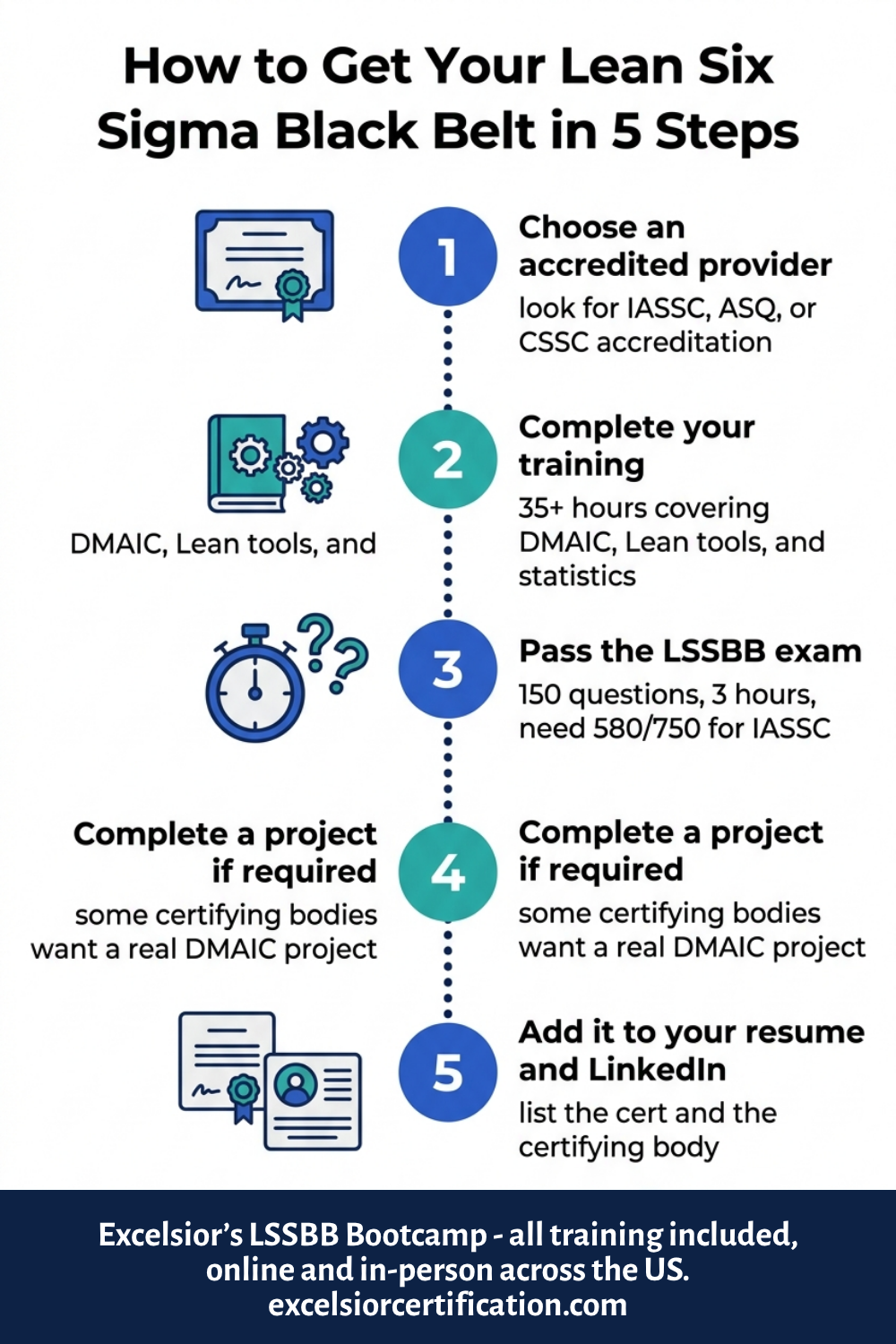
Step 1 – Pick an accredited provider. This matters. Not every course leads to a recognized credential. Look for IASSC, ASQ, or CSSC. Excelsior is aligned with both IASSC and CSSC.
Step 2 – Complete your training. Excelsior’s LSSBB bootcamp is instructor-led, online, or in-person. You’ll cover DMAIC, Lean tools, hypothesis testing, regression, control charts, design of experiments, everything the exam covers, and everything you’ll actually use on projects.
Step 3 – Take the exam. Most people give themselves 2-4 weeks of prep after finishing training. Excelsior includes practice exams and simulated questions, so you know what to expect.
Step 4 – Complete a project if your certifying body requires one. Excelsior walks you through this. It doesn’t have to be massive; it just needs to show you applied DMAIC to a real process and got measurable results.
Step 5 – Add it everywhere. Resume. LinkedIn. List it as Lean Six Sigma Black Belt (LSSBB) with the certifying body. Recruiters filter for this.
How long does the whole thing take?
Training done in 3-5 days with Excelsior’s bootcamp. Exam prep takes 2-4 weeks. Most people have their certification within 4-6 weeks of starting.
View Excelsior’s LSSBB Training
Download the Free LSSBB Course Brochure
LSSBB vs PMP – Not the Same Thing
People mix these up, and they really shouldn’t. Both are respected professional certifications. But they’re for different things.
PMP is about managing projects, scoping them, planning timelines, managing budgets, and leading teams to deliver on schedule. Issued by PMI. Requires 3-5 years of project management experience before you can even apply.
LSSBB is about improving processes, finding what’s broken, using data to confirm why it’s broken, and fixing it in a way that produces measurable results. No strict experience requirement for most providers.
| LSSBB | PMP | |
| What it’s for | Process improvement | Project delivery |
| Core method | DMAIC, Lean tools | PMBOK, Agile |
| Statistics | Advanced | Minimal |
| Experience req. | Usually none | 3-5 years |
| Avg salary | $132,800 | $130K-$150K+ |
| Best for | Quality, ops, CI roles | Project managers |
Can you get both? Yes. A lot of people do. PMP + LSSBB is a strong combo for operations director, VP of Quality, or senior project leadership roles. The skills genuinely complement each other.
View PMP Certification Training
View LSSGB + LSSBB Combo Course
Where LSSBB Takes Your Career
Here are the most common places Black Belt-certified professionals end up in the US:
Continuous Improvement Manager. You lead a team of Green and Yellow Belts and run ongoing improvement projects. Very common in manufacturing, healthcare, and logistics. Salary range $110,000-$140,000.
Six Sigma Consultant. Internal (within one company) or external (multiple clients). External consultants charge $150-$300 an hour once they have completed projects with real results behind them.
Director of Quality or VP of Quality. Usually, people land after 5-10 years as a Black Belt. Senior leadership, significant salary, $150,000-$200,000+.
Operations Manager. A lot of operations management postings now list LSSBB as preferred or required. You run day-to-day operations while also driving improvement work. Typically $120,000-$160,000.
Supply Chain roles. Especially at companies like Amazon, Dell, and FedEx. Black Belt methods are core to how they run distribution and fulfillment.
Master Black Belt. Some people eventually move from running projects to coaching others and guiding strategy. Average $180,400 a year. (Source: Salary.com 2026)
“Once a student has two or three completed Black Belt projects with real savings numbers they can point to, the career options change pretty fast. Employers who know what a Black Belt project looks like, they understand what they’re getting. It’s one of those credentials that comes with proof.” – Paula S. Shafer, LSSBB, Excelsior Certification
Questions People Actually Ask About LSSBB
What does LSSBB stand for?
LSSBB stands for Lean Six Sigma Black Belt. It’s an advanced professional certification for people who lead complex process improvement projects using Lean and Six Sigma methods.
What is the LSSBB salary in the US?
The national average is $132,800 a year, according to Salary.com (2026). Financial services pay the most at a $182,621 median. (Source: Glassdoor April 2026)
Do I need a Green Belt before Black Belt?
No. LSSBB training covers everything from the ground up. You can go straight to Black Belt.
What is DMAIC?
Define, Measure, Analyze, Improve, Control. The five-step problem-solving framework is used on every Lean Six Sigma project.
What’s the difference between LSSBB and LSSGB?
Green Belt leads department-level projects. Black Belt leads enterprise-level, cross-functional projects with more advanced statistical tools. Black Belts also mentor lower-belt team members and earn about $13,000 more a year on average.
How long does LSSBB certification take?
Training is 3-5 days with Excelsior’s bootcamp. Add 2-4 weeks of exam prep. Most people are certified within 4-6 weeks of starting.
Which industries hire Black Belts?
Manufacturing, healthcare, financial services, IT, aerospace, supply chain, and government. It’s not industry-specific.
Is LSSBB the same as Six Sigma Black Belt?
Not exactly. LSSBB combines Lean (waste elimination) with Six Sigma (defect reduction). A standalone Six Sigma Black Belt is only the Six Sigma side. LSSBB is the more complete and more commonly used version in 2026.
Can I get both PMP and LSSBB?
Yes, and a lot of people do. PMP + LSSBB together is a strong combination for senior operations and quality leadership roles.
What does LSSBB certification cost?
Training typically runs $1,000-$3,000, depending on the provider. Exam fees are usually $100-$400. See Excelsior’s LSSBB pricing here.
Is LSSBB worth getting without work experience?
The credential has value at any stage. But the real return comes from using the skills on actual projects. If you’re early in your career, Green Belt is a good starting point.
Which certifying body is best?
IASSC and ASQ are the most globally recognized. CSSC is respected in the US, especially in manufacturing. Excelsior aligns with both IASSC and CSSC.
What to Do Next
Now you know what LSSBB means, what Black Belts actually do, what they get paid, and how the certification works.
If you’re ready to get certified, Excelsior’s LSSBB course has everything you need, all training hours, exam prep, expert instructors, and both online and in-person options across US cities.
If you want to compare belt levels first, the LSSGB + LSSBB Combo is worth looking at; you earn both certifications together and save on the total training cost.
And if you just want to grab the free course brochure before deciding anything, that’s at the free resources page.
Get Lean Six Sigma Black Belt Certified with Excelsior
Body: Instructor-led LSSBB bootcamp, online and in-person. All training hours included. IASSC and CSSC are aligned. 99.6% first-attempt pass rate. 500+ professionals certified.
Read Next
Lean Six Sigma Black Belt Training
Lean Six Sigma Green Belt Training
Lean Six Sigma Yellow Belt Training