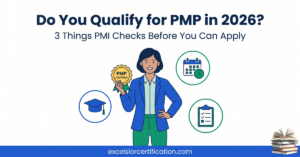
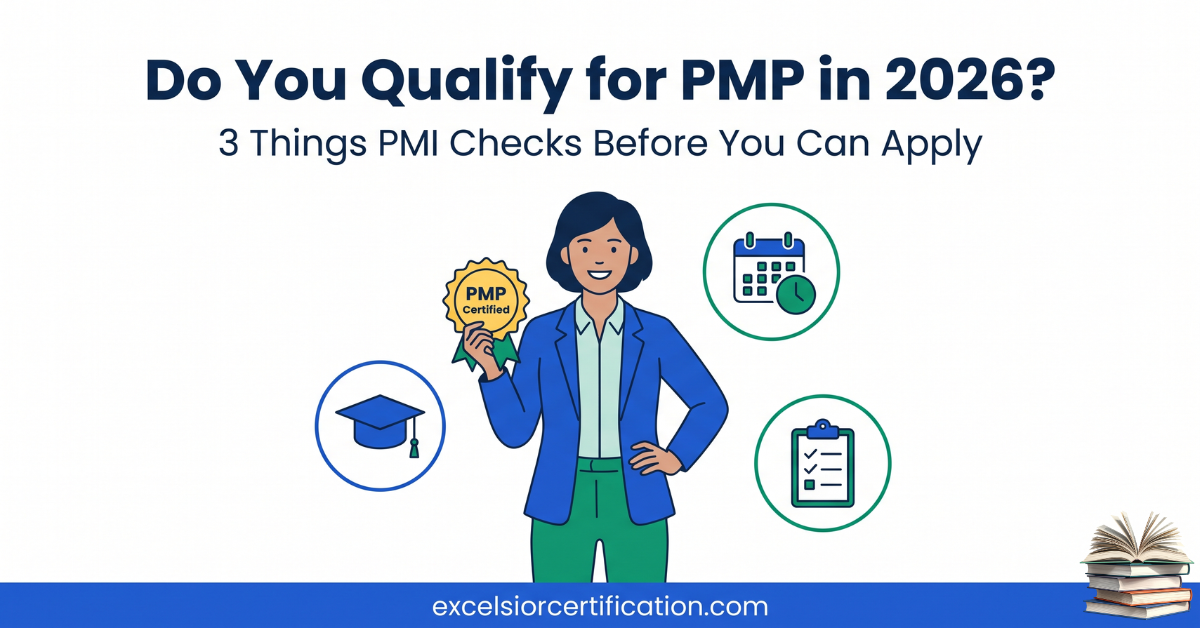
So you’ve been hearing about PMP certification everywhere, in job postings, from colleagues, on LinkedIn. And now you’re thinking: do I actually qualify for this?
The good news is you probably do. But PMP is not like most certifications, where you just sign up and take a test. PMI has real requirements. You have to show proof of your education, your work experience, and your training hours before they’ll even let you apply.
This guide covers every PMP prerequisite for 2026 in plain, simple language, including the major exam update happening in July 2026 that every candidate needs to know about. By the end, you’ll know exactly where you stand and what your next step should be.
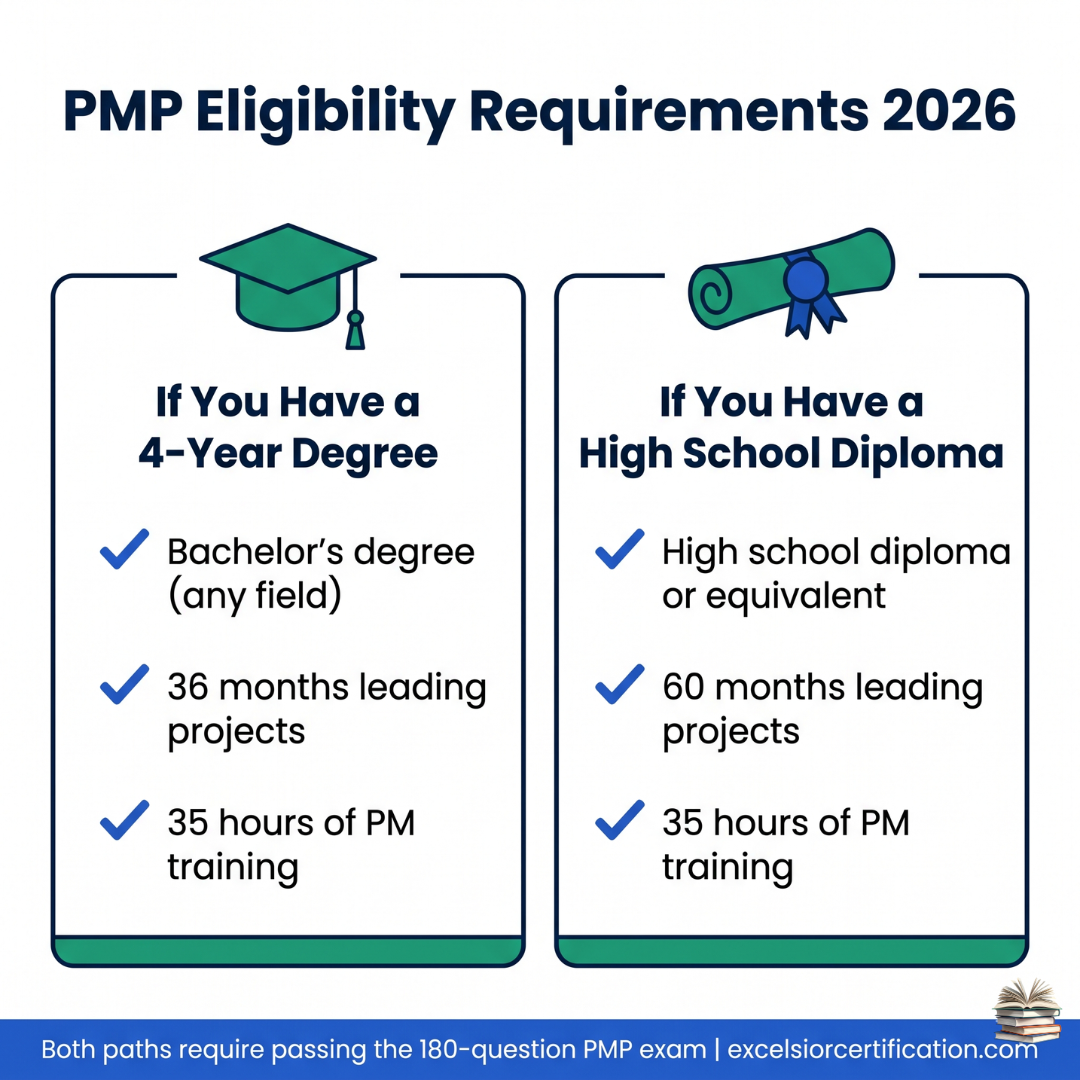
Quick Answer: To qualify for PMP in 2026, you need one of these two paths:
- Path 1: 4-year college degree + 36 months of project leadership experience + 35 hours of PM training
- Path 2: High school diploma or GED + 60 months of project leadership experience + 35 hours of PM training
(Source: pmi.org)
Table of Contents
What Is PMP Certification?
PMP stands for Project Management Professional. It is a certification given by PMI, the Project Management Institute, which is the world’s largest professional organization for project managers.
More than 1 million professionals worldwide hold the PMP. It is recognized in over 200 countries and accepted across every major industry, including IT, healthcare, construction, finance, government, and more. (Source: PMI.org)
It’s not a beginner credential. PMI designed it for people who already manage or lead projects at work. That’s exactly why employers pay more for it. According to PMI’s 2023 Salary Survey, PMP holders earn 33% more than their non-certified peers globally, and 17% more on average across the 21 countries surveyed.
If you manage projects or want to move up into a role that does, PMP is the most respected credential you can put on your resume.
Who Is PMP Certification For?
PMP is built for working professionals who already have hands-on project experience. You don’t need the job title “Project Manager” to qualify; you just need to have led or directed projects in a paid professional role.
PMP makes sense for you if:
- You currently lead projects, manage teams, or oversee deliverables at work
- You have at least 3 years of project leadership experience
- You want to move into a senior PM, program manager, or PMO role
- You work in IT, construction, engineering, healthcare, finance, government, or consulting
- You want a globally recognized credential that opens doors in the US and internationally
Not there yet experience-wise? Start with CAPM Certification Training, which is designed for early-career project professionals and has no experience requirement.
PMP Certification Requirements 2026 at a Glance
Here is the simple breakdown. PMI gives you two paths to qualify, depending on your education level:
| Your Education | Project Experience Needed | Training Hours |
| 4-year college degree (any field) | 36 months (3 years) | 35 hours |
| High school diploma or GED | 60 months (5 years) | 35 hours |
Those are the three boxes PMI checks. Let’s go through each one so you know exactly what counts and what doesn’t.
Requirement 1 – Your Education
PMI accepts two levels of education for PMP eligibility.
Option A — A 4-year college degree
This means any bachelor’s degree from an accredited university. It does NOT need to be in project management, business, or any related field. An engineering degree, a nursing degree, and a history degree all qualify. You need to show that you completed a 4-year program.
Option B — A high school diploma or GED
If you didn’t finish college, that is completely fine. PMI accepts a high school diploma or its equivalent. If you take this path, you’ll need more work experience (60 months instead of 36) to make up for it.
Two common questions about education:
Does my degree need to be from a US school? No. PMI accepts degrees from institutions worldwide. There is no requirement for accreditation from a specific US body.
What if I have a master’s degree? A master’s degree still falls under the “4-year degree” path. Having a higher degree does not reduce your experience requirement; it still stays at 36 months.
Trainer Tip: “We get this question a lot in class. Students worry their degree isn’t ‘right’ for PMP. The truth is, PMI cares far more about your work experience than your major. I’ve helped nurses, teachers, and military veterans get PMP certified. Your degree is just a checkbox.” — [Paula S. Shafer, PMP, LSSBB, Excelsior Certification]
Requirement 2 – Your Work Experience
This is the most important requirement, and the one people get most confused about.
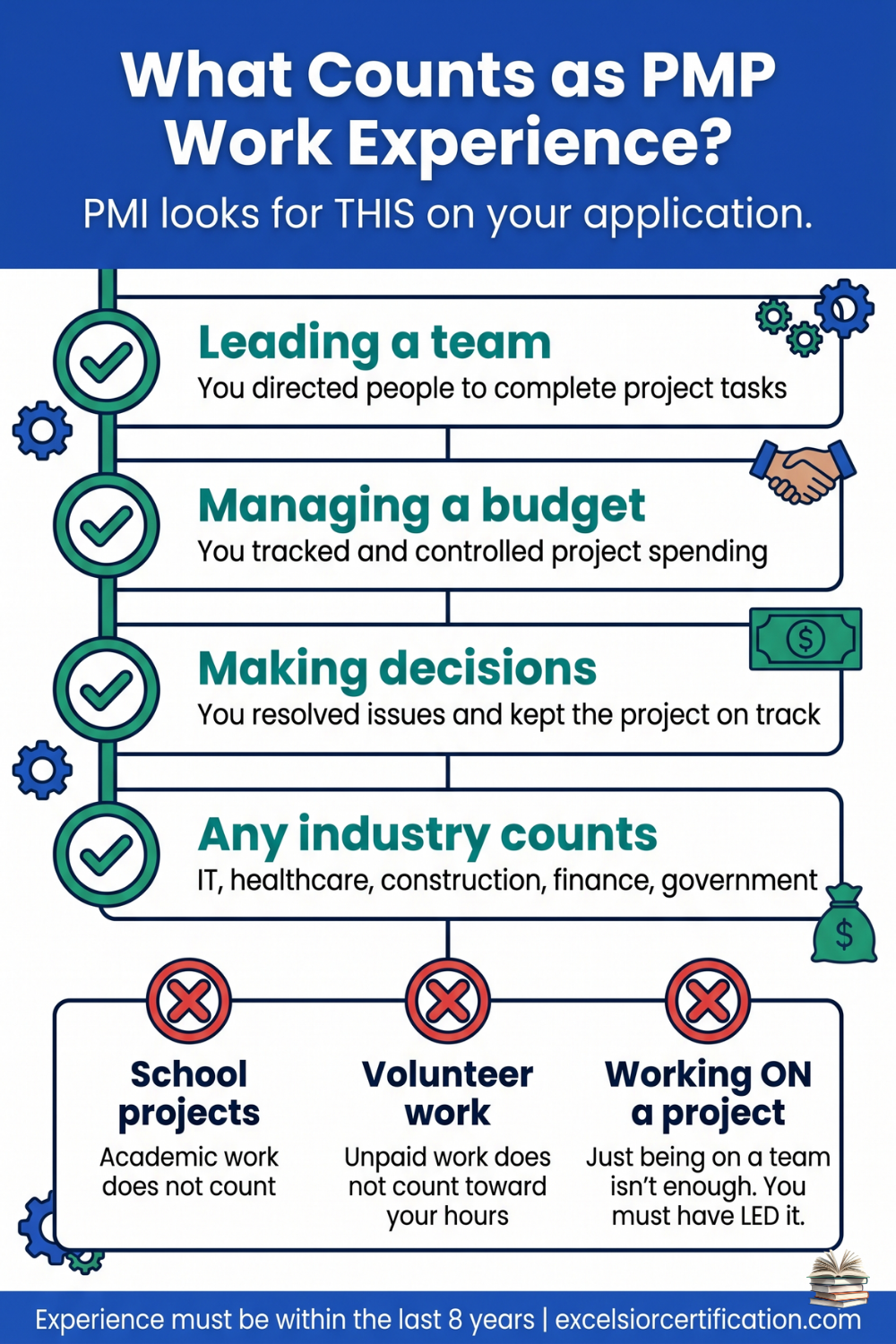
PMI doesn’t just want to see that you worked on projects. They want to see that you led and directed them. There is a big difference between being part of a project team and actually running a project.
What counts as qualifying PMP experience:
Your experience must show that you were responsible for making decisions, directing the work of others, or steering a project toward its goal. You do not need the title “Project Manager.” Many PMP holders qualified with titles like:
- Team Lead
- Operations Manager
- IT Manager
- Program Coordinator
- Business Analyst
- Construction Superintendent
- Department Head
How much experience do you need:
| Education Level | Experience Required |
| 4-year degree | 36 months (3 years) |
| High school diploma / GED | 60 months (5 years) |
Important rules about your experience:
Does it need to be consecutive? No. PMI adds up your total project leadership experience across all jobs. If you led projects at three different companies over six years, those months all count together.
Does it need to be full-time? Yes, your experience must be paid, professional work. PMI requires it to be in a professional setting.
What is the time limit on experience? According to the 2026 PMP Examination Content Outline published by PMI, all project management experience must have been accrued within the last 10 years before your application. (Source: PMI 2026 ECO, p.11)
One mistake we see all the time: Candidates list experience from 12–15 years ago that no longer qualifies. Always count backward from your application date and make sure your experience falls within the 10-year window.
Requirement 3 – 35 Hours of Project Management Training
This is the requirement that surprises most people, especially those who have years of experience but haven’t taken a formal course.
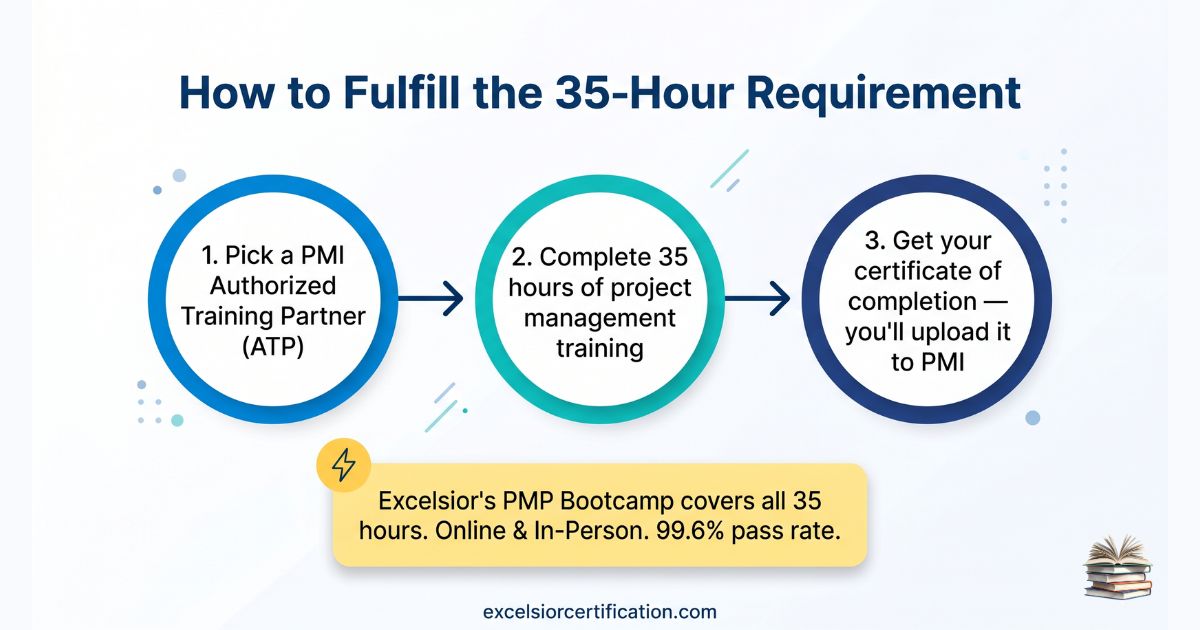
PMI requires you to complete 35 contact hours of formal project management education before you can submit your application. These are sometimes called “education hours” or “PDUs.”
What exactly are 35 contact hours?
It means 35 hours of structured instruction from a recognized training provider, with a certificate at the end. Reading books, watching free YouTube videos, or self-studying does not count toward this requirement. (Source: PMI.org)
What kind of training qualifies?
- Instructor-led bootcamps (in-person or live virtual)
- Online/Classroom courses from a PMI-Recognized Training Partner Trainer
- Courses from accredited academic programs
- On-demand courses that cover the PMP Exam Content Outline topics, which is exactly what Excelsior Certification is.
Does the topic matter?
Yes. Your 35 hours must cover project management subjects, things like project planning, risk management, budgeting, scheduling, and team leadership. A general business course won’t count.
One exception to the 35-hour requirement:
If you currently hold an active CAPM certification, you are automatically exempt from the 35-hour training requirement. Your CAPM counts as proof of your education hours.
Ready to Check Off Your 35 Hours?
Excelsior Certification is a PMI-Recognized Training Partner. Our PMP Bootcamp covers all 35 required training hours, online or in-person, with a 99.6% first-attempt pass rate and expert instructor support throughout.
Download the PMP course brochure
The July 2026 PMP Exam Update – What Every Candidate Must Know
This is the most important update in the PMP world right now, and most candidates don’t know about it yet.
PMI is launching a significantly updated PMP exam on July 9, 2026. The eligibility requirements (education, experience, 35 hours) are NOT changing, but what the exam tests IS changing. Here is what’s new:
What’s changing in the July 2026 exam:
The exam still covers three domains: People, Process, and Business Environment. But PMI has rebalanced how much weight each domain gets and added new topics:
| Domain | Old Weighting | New Weighting |
| People | 42% | 33% |
| Process | 50% | 41% |
| Business Environment | 8% | 26% |
The Business Environment domain is now three times larger than before. This reflects PMI’s push to test whether project managers understand how their projects connect to real business outcomes, not just timelines and budgets.
New topics added to the 2026 exam:
- Artificial Intelligence (AI) in project management
- Sustainability and environmental impact
- Stakeholder engagement and value delivery
- Digital collaboration tools
- Power Skills (leadership, emotional intelligence, communication)
These changes align with the PMBOK® Guide 8th Edition, published in late 2025.
What this means for you:
If you plan to take the exam before July 9, 2026, use current study materials and take the exam as soon as possible under the existing format.
If you plan to take the exam after July 9, 2026, make sure your training provider and study materials reflect the 2026 ECO (Exam Content Outline). Excelsior’s instructors are already updated for the new exam format.
“The July 2026 update is the biggest change to the PMP exam in years. It shifts the focus from memorizing processes to demonstrating real leadership and business judgment. Students who prepare with scenario-based practice questions and understand the ‘why’ behind project decisions will do much better than those who just memorize frameworks.” – [Paula S. Shafer., PMP, Excelsior Certification]
How to Apply for PMP Certification – Step by Step
Once you meet the PMP prerequisites, here is exactly how the application process works:
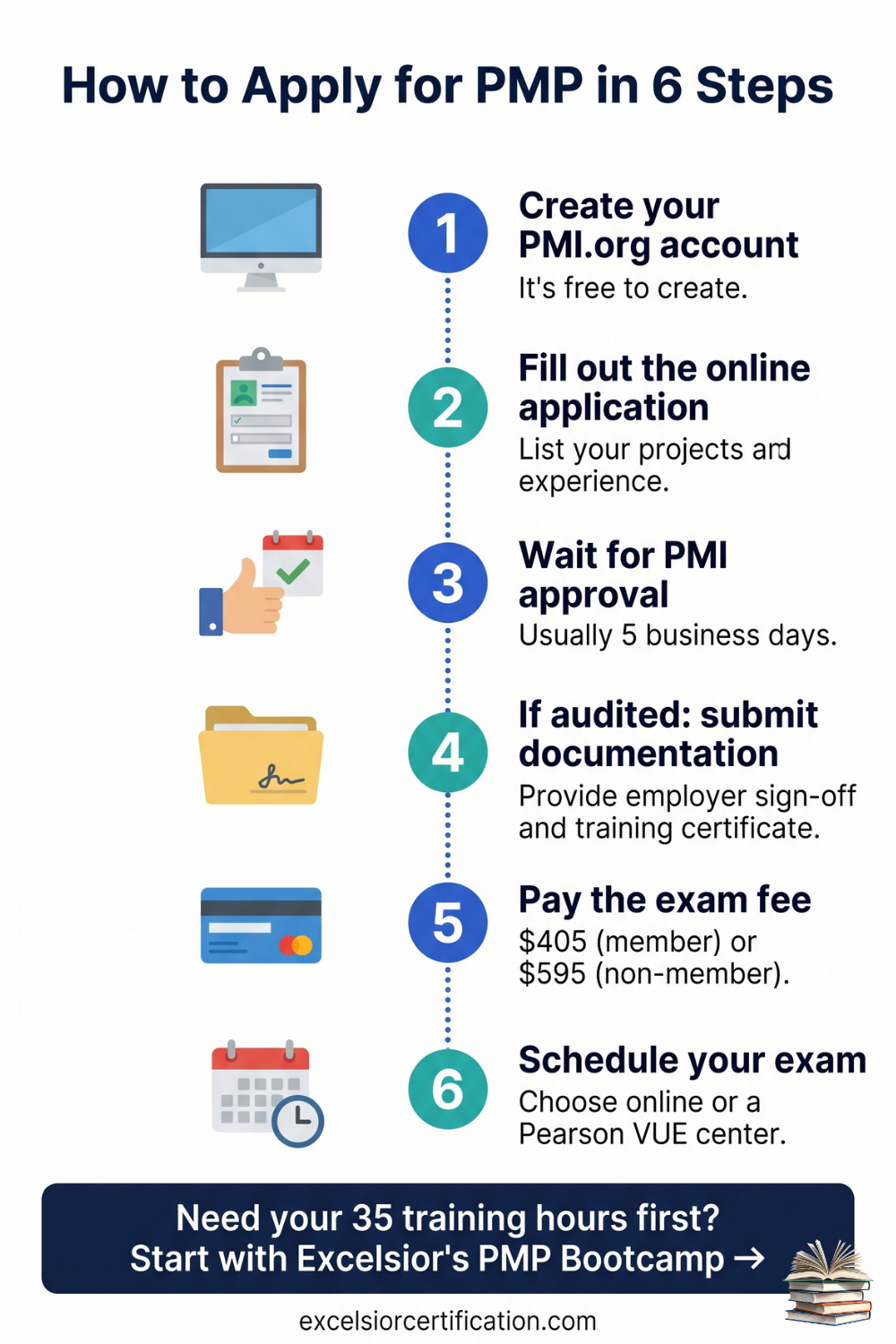
Step 1: Create your PMI account
Go to PMI.org and create a free account. Everything, your application, payment, and exam scheduling, happens through this account.
Step 2: Fill out the online application
PMI will ask you to describe your project experience. For each project, you write a summary of your role, the project’s purpose, and how many months you were involved. You do not need to list every project you’ve ever worked on, just enough to reach your required months (36 or 60).
Step 3: Submit and wait for approval
PMI typically reviews and approves applications within 5 business days. Most candidates are approved without issues.
Step 4: Prepare for a possible audit
PMI randomly audits a percentage of all applications. If you’re selected, you’ll need to provide signed letters from your employers confirming your experience and a copy of your training certificate. Being accurate and honest in your application means that an audit is nothing to worry about.
Step 5: Pay the exam fee
Once approved, you pay for the exam:
- PMI members: $425
- Non-members: $675
PMI membership costs $164 per year (plus a one-time $10 application fee). Since it saves you $250 on the exam fee alone, it effectively pays for itself immediately.
Step 6: Schedule your exam
After payment, you have one year to take the exam. You can take it from home (online proctored through Pearson VUE) or at a Pearson VUE testing center near you.
For the complete cost breakdown, including how to save money: PMP Certification Cost in the US — 2026 Guide
PMP Exam Format, Domains & What to Expect
Basic exam facts (2026):
| Detail | Info |
| Number of questions | 180 |
| Time allowed | 230 minutes (~4 hours) |
| Scheduled breaks | Two 10-minute breaks |
| Question types | Multiple choice, drag-and-drop, matching, fill-in-the-blank |
| Exam delivery | Online proctored or Pearson VUE test center |
| Passing score | Determined by PMI psychometrics, not published |
The three exam domains (post-July 2026):
| Domain | Focus | Weight |
| People | Leading teams, stakeholder relationships, and emotional intelligence | 33% |
| Process | Project planning, execution, risk, schedule, and budget | 41% |
| Business Environment | Strategy, AI, sustainability, value delivery | 26% |
About half of the exam questions cover predictive (waterfall) approaches, and half cover agile or hybrid approaches. This means you need to be comfortable with both, not just one.
Scoring: PMI uses psychometric analysis to score results. You will see one of four ratings: Above Target, Target, Below Target, or Needs Improvement. You have three exam attempts within your one-year eligibility window if needed.
PMP Certification Cost 2026
Here is a realistic picture of what PMP costs:
| Cost Item | Amount |
| PMI exam fee — non-member | $675 |
| PMI exam fee — member | $425 |
| PMI membership (optional but smart) | $164/year + $10 one-time fee |
| 35-hour training course | $300–$2,000 depending on provider |
| Retake fee — member | $275 |
| Retake fee — non-member | $375 |
| Renewal every 3 years — member | $60 |
| Renewal every 3 years — non-member | $150 |
The smart path: join PMI, pay $425 for the exam, and choose a quality training provider. Your total with Excelsior’s training starts at well under $1,000.
For the full breakdown with tips on employer reimbursement, study material costs, and how to save money: PMP Certification Cost in the US
How Long Does It Take to Get PMP Certified?
Here is a realistic timeline for most US candidates:
| Stage | Time Required |
| Complete 35 hours of training | 2-4 days (bootcamp) or 4-6 weeks (self-paced online) |
| Prepare and submit the PMI application | 1-2 weeks |
| PMI reviews and approves the application | Up to 5 business days |
| Study for the exam | 4-8 weeks |
| Schedule and take the exam | 1-2 weeks after completing the study |
| Total start to PMP certification | 2-4 months |
The fastest path is an intensive bootcamp. Excelsior’s course gives you all 35 hours in a weekend, so you can move straight into exam prep.
PMP Renewal – What Happens After You Pass?
Passing the PMP exam is not the finish line. Your certification is valid for 3 years. To keep it active, you must earn 60 PDUs (Professional Development Units) every 3-year cycle.
The 3 PDU categories (PMI Talent Triangle®): PMI now requires a minimum of 8 PDUs in each of the three categories:
- Ways of Working – Methods, tools, and approaches (agile, predictive, hybrid)
- Power Skills – Leadership, communication, emotional intelligence
- Business Acumen – Strategy, finance, market awareness
PDUs can come from taking courses, attending PMI webinars, working as a PM, volunteering with PMI chapters, or giving talks and writing articles on project management.
Renewal fees:
- PMI members: $60
- Non-members: $150
This is another reason PMI membership pays off year over year, not just at the application stage. Excelsior’s PMP Certification Training and continuing education courses can help you earn PDUs toward renewal, too.
What If You Don’t Qualify Yet?
PMP has real entry requirements, and that’s okay if you’re not there yet. Here are your options:
Option 1 – Get CAPM certified first
The CAPM (Certified Associate in Project Management) is PMI’s entry-level certification. It only requires 23 hours of education and a secondary school diploma; no work experience is needed. It gives you a real PMI credential on your resume while you build toward PMP.
→ CAPM Certification Training at Excelsior
Option 2 – Complete your 35 training hours now
Your training certificate doesn’t expire. You can take Excelsior’s PMP course today, save your certificate, and submit your PMP application the moment your experience catches up. Many smart candidates do this so they’re ready to apply the day they hit their months.
Option 3 – Start documenting your experience now
Most people have more qualifying experience than they realize; they just haven’t looked at their job responsibilities through the right lens. Start writing down every project you’ve led, even informally. Those months add up.
“One of our students came in thinking she wasn’t close to qualifying. After we worked through her experience together, she had more than enough hours; she just hadn’t framed it as project leadership before. Don’t assume you don’t qualify until you’ve actually mapped it out.” — [Paula S. Shafer., Excelsior Certification]
CAPM vs PMP – Which Certification Is Right for You?
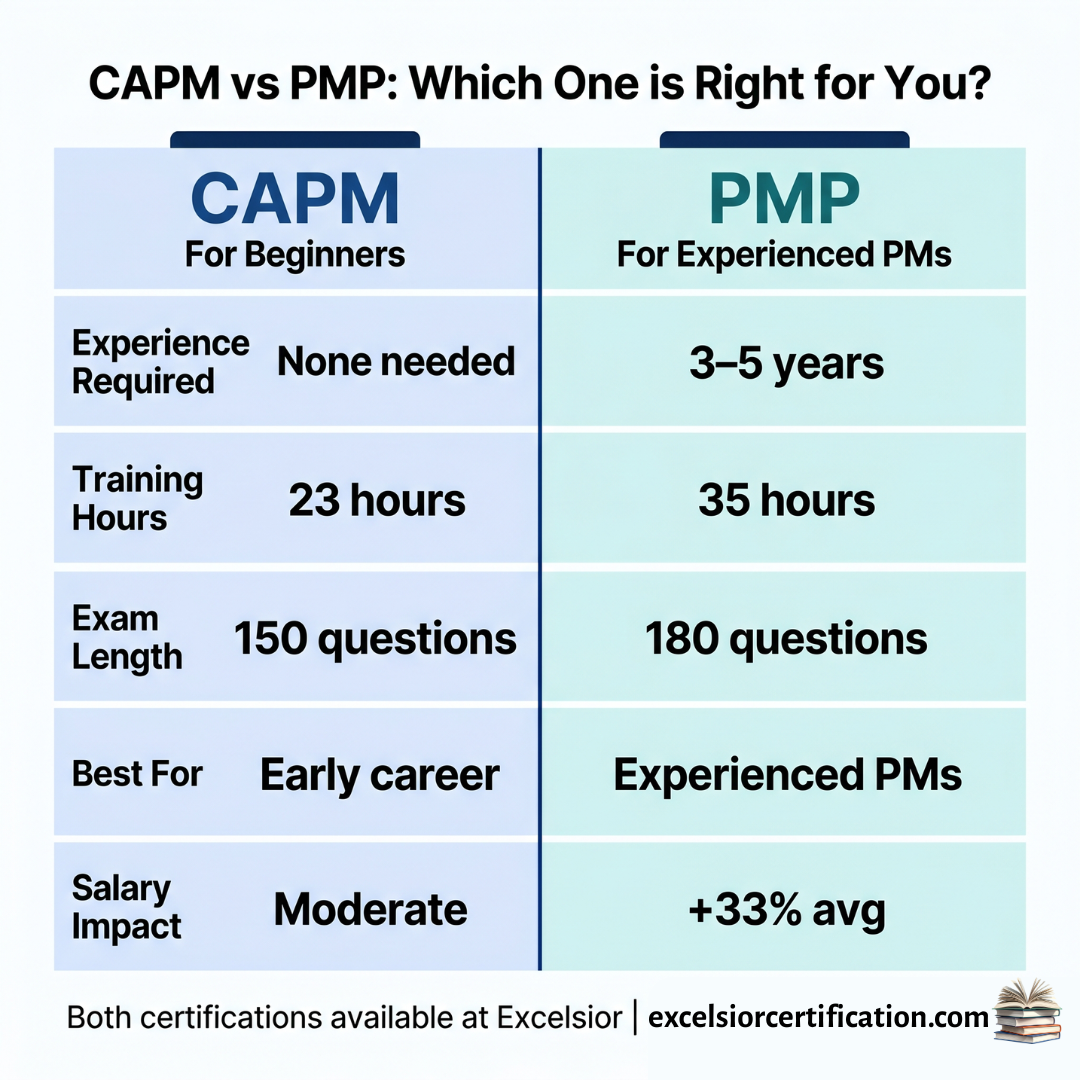
Not sure which certification fits where you are right now? Here’s a clear comparison:
| CAPM | PMP | |
| Experience | None needed | 3–5 years |
| Training | 23 hours | 35 hours |
| Exam | 150 questions | 180 questions |
| Best for | Starting out | Advancing career |
| Salary boost | Moderate | +33% avg (PMI Survey) |
Both certifications available at Excelsior Certification
| CAPM | PMP | |
| Work experience required | None | 36–60 months |
| Minimum education | High school diploma | High school diploma |
| Training hours | 23 hours | 35 hours |
| Exam questions | 150 | 180 |
| Valid for | 5 years | 3 years (renew with 60 PDUs) |
| Best for | Early-career PMs | Experienced PMs |
| Average salary impact | Moderate | +33% vs non-certified peers |
If you have the experience, go straight to PMP. If not, CAPM is the smart first step.
→View CAPM Certification Training →View PMP Certification Training
Common PMP Application Mistakes to Avoid
Every year, thousands of candidates get their PMP applications delayed or audited because of avoidable mistakes. Here are the most common ones, and how to avoid them:
Mistake 1: Listing experience older than 10 years
PMI only counts experience from the last 10 years. Experience from 2012 or earlier does not qualify for a 2026 application. (Source: PMI 2026 ECO)
Mistake 2: Describing what the project did, not what you did
PMI wants to see your role. Write “I led a cross-functional team of 8 to redesign the customer onboarding process,” not “the project involved redesigning the onboarding process.”
Mistake 3: Using a non-qualifying training provider for your 35 hours
Not every project management course counts. After Q4 2026, live training must come from a PMI ATP or an eligible academic program. Use a PMI-Recognized Training Partner, like Excelsior, to guarantee your hours are accepted.
Mistake 4: Forgetting to save your training certificate
PMI will ask for it during the application and potentially during an audit. Make sure you have a digital copy saved before you start your application.
Mistake 5: Overlapping experience months
If you led two projects at the same time, those months count only once, not twice. PMI requires non-overlapping experience. (Source: PMI Handbook 2026)
Mistake 6: Not preparing for a potential audit
About 10–20% of applications are randomly selected for audit. Have signed letters from your managers or clients ready before you submit. If your experience is real and accurately documented, an audit is straightforward.
Frequently Asked Questions About PMP Requirements
What are the PMP certification requirements in 2026?
PMP certification requirements in 2026 are: a 4-year college degree (any field) plus 36 months of project leadership experience plus 35 hours of formal PM training, or a high school diploma plus 60 months of experience plus 35 training hours.
Can I get PMP certified without a college degree?
Yes. PMI accepts a high school diploma or GED. If you don’t have a 4-year degree, you’ll need 60 months (5 years) of project leadership experience instead of 36 months.
What counts as qualifying work experience for PMP?
Paid professional work where you led or directed projects, including making decisions, managing teams, controlling budgets, or guiding a project through its phases. The job title “Project Manager” is not required. Experience must be from the last 10 years.
How do I get the 35 training hours required for PMP?
Enroll in a course from a PMI Recognized Training Partner. Excelsior Certification is a PMI ATP. Our PMP Certification Training covers all 35 required hours with instructor-led online and in-person options.
Does my experience need to be in consecutive months?
No. PMI adds up your total accumulated experience across all employers. You can combine months from multiple jobs as long as they don’t overlap.
What is the PMP exam fee in 2026?
$675 for non-PMI members, $425 for PMI members. PMI membership costs $164/year. Since it saves you $250 on the exam, it pays for itself immediately. See full cost guide: PMP Certification Cost in the US
What is changing about the PMP exam in July 2026?
PMI is launching a new PMP exam on July 9, 2026, with rebalanced domain weightings and new topics, including AI, sustainability, and value delivery. The eligibility requirements (education, experience, 35 hours) are not changing. Candidates testing after July 9 should use study materials aligned to the 2026 Exam Content Outline.
What happens if PMI audits my PMP application?
You’ll need to provide signed verification letters from your employers and a copy of your training certificate. Being accurate in your application means an audit is simple to pass. Prepare your documents before submitting.
How long does it take to get PMP certified?
Most US candidates complete the full process in 2-4 months: training, application, study, and exam.
What is the difference between PMP and CAPM?
CAPM is PMI’s entry-level certification with no experience requirement (just 23 hours of training). PMP requires 3–5 years of project leadership experience. PMP carries significantly more weight in the job market and salary impact.
Do I need to renew my PMP certification?
Yes. PMP is valid for 3 years. You must earn 60 PDUs every 3-year cycle to maintain it, including at least 8 PDUs each in the Ways of Working, Power Skills, and Business Acumen categories.
Is PMP worth it in 2026?
Yes. PMP holders earn 33% more than non-certified peers globally, according to PMI’s 2023 Salary Survey. PMI also projects that 2.3 million project management roles will need to be filled every year through 2030. PMP is the most recognized credential in the field.
Can a self-employed person apply for PMP?
Yes. Self-employed project managers can apply; you’ll need to provide client references and project documentation to verify your experience.
Your Next Step
You now know exactly what PMI requires in 2026. The question is, what do you do first?
If you already qualify: The smartest move right now is to enroll in your 35-hour training before the PMI live training rule tightens in Q4 2026. After that, your application is ready to go.
If you need more experience, start with CAPM. Build your credentials, add a real PMI certification to your resume, and set yourself up for PMP when your experience catches up.
Either way – your next step is here:
Get PMP Certified with America’s Trusted PMI-Recognized Training Partner
Excelsior Certification has helped 500+ professionals earn their PMP with a 99.6% first-attempt pass rate. Our PMI ATP-certified PMP Bootcamp covers all 35 required training hours, online and in-person, across US cities. Expert instructors. Simulated exams. Money-back guarantee.
Download the PMP course brochure
Read Next
> PMP Certification Training — Online & In-Person
> PMP Certification Cost 2026 — Full US Breakdown
> PMP Certification Guide 2026
> Free PMP Study Resources — Download PDF